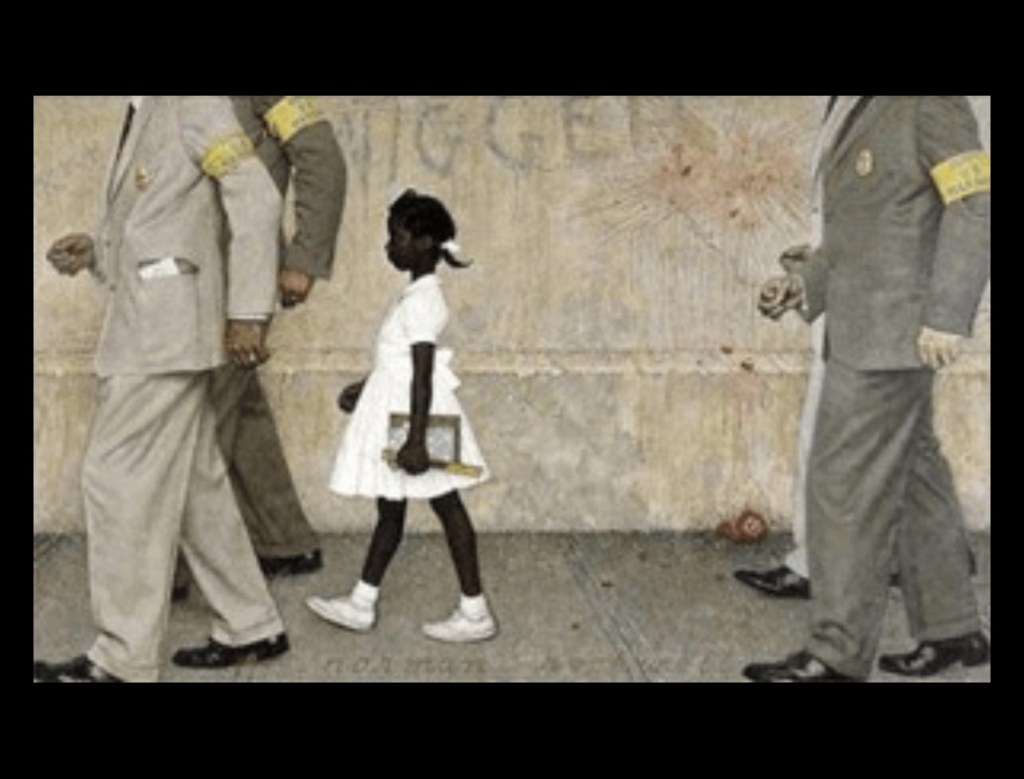
Norman Rockwell captured the woes of attending public education as a Black American back in 1963 with “The Problem We All Live With”. Although Ruby Bridges’ experience is incomparable, is it still painstakingly obvious that our schools are still segregated by classism, under-protected, and unsafe for our society’s children. Norman’s painting paid extremely well attention to detail. The anonymity of the men walking her into school for protection, the tomatoes splattered against the wall, and Ruby Bridges carrying her head and her book high at 6. This image is painfully still a reality today in a sense. With AP African American studies under attack, specifically in our state, it is imperative we have this conversation as a society. Have things changed much since Ruby Bridges? Was it Norman Rockwell‘s intention to capture such an everlasting situation?
Ruby Bridges was a child, aged 6, who was subjected to the ill feelings of adult people without restraint. These people despised the thought of a young black child pursuing education. Norman captures that reality within the painting by clearly sending the message the Ruby was not welcome. Adults who could not look beyond her physical attributes and recognize the genius in all minds? We all deserve a chance! Starting with a quality and whole education, free of bias. Where would be as a society if all these barriers did not exist? The breakdown of the artistic values of the photo gives a more in-depth look at how meticulous every detail in this painting was.
Color is one of the most important aspects of this photo. What would the cultural significance be if race were not the focal point of the picture? In plain words, it gives the photo depth. Ruby is obviously a black child and, given the history of racism in American, race was an important aspect in 1963 and to this photo. For other example, the pale colors of the bodyguards’ suits give an “official” feeling. This points to the fact that Ruby is likely being escorted by people designated to be there for her protection. If this picture did not highlight the tones of skin or the color of what each person is wearing, would its significance still be recognizable?
(Rockwell)
Lines are the most inquisitive visual aspect of the photo to me. There could be lines anywhere in a picture. This photo reflects lines that not only build the atmosphere but give significance to the clothing/genders of the subject and were used to form the “N” word in the background that really gave the photo its great significance. Without lines, a lot of photos would lose their significance and even sense of reality. The lines in “The Problem We All Live With” are mostly rigid and firm. This gives a sense of firm realism and coldness that makes the photo real and extremely sad, for most. Could THAT word be written without lines? Can you draw people accurately without them?
Unfortunately, in a society where race precedes all, education is impacted the most. Norman Rockwell’s painting “The Problem We All Live With” cemented that into truth, visually. Segregation in education in America was amplified by this photo and sparked a generationally conversation that is still happening today. African American AP studies was just recently banned in Florida because of ONE politician’s personal view about Critical Race Theory. Is it just for a human to deny the existence and quality of life of an entire people because of subjective opinions? From 1963 to this day, race and inequality still corrode our educational system and many other aspects of our society from the inside out. While uncomfortable, it is important that this topic continues to be at the forefront of our generation’s history. If not for our survival, at least for the generations of the future.
Works Cited
Rockwell, Norman. “”The Problem We All Live With” – Norman Rockwell (1894-1978) – Google Arts & Culture.” Google Arts & Culture, artsandculture.google.com/asset/the-problem-we-all-live-with-norman-rockwell-1894-1978/qwGpXUCsX0RPAQ. ReplyForward
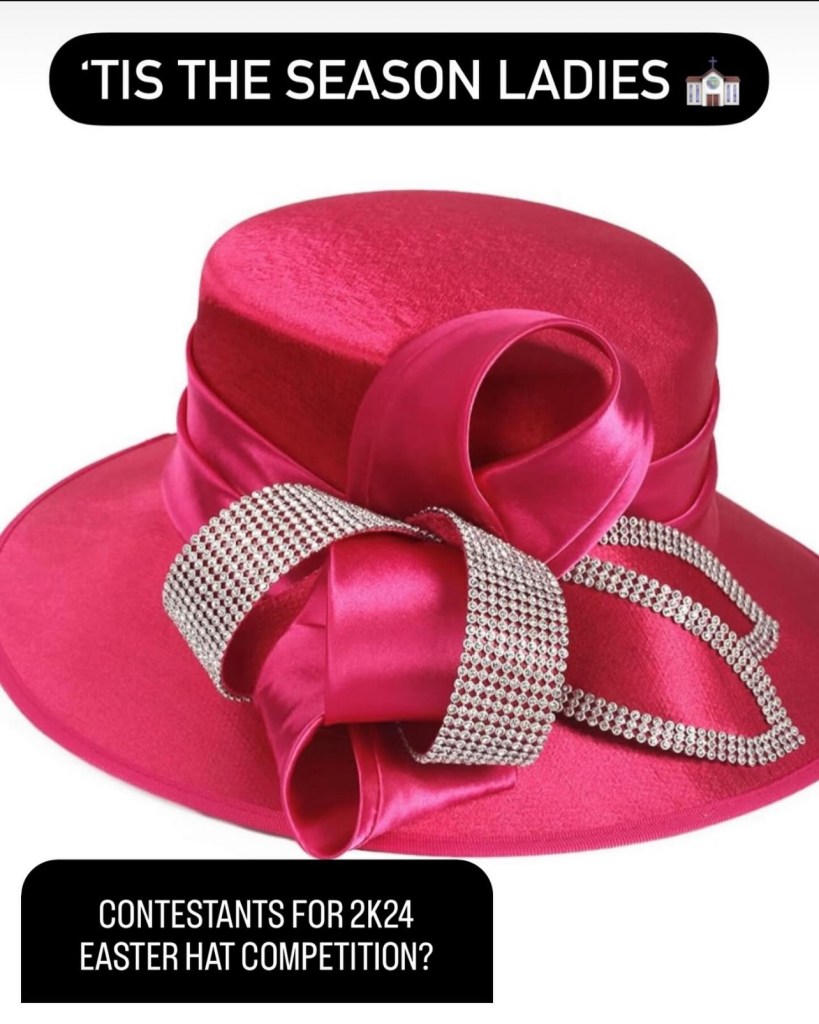
This year we’re kicking off our first annual Easter hat competition. Submit your best Easter hat shot on Easter Sunday to ebonyqueen@queendomentertainment.com to be entered in the competition.
Good day, my name is Ebony and today I will be using this book to introduce myself to you all. I have chosen a book because there are many layers to books, but those layers all embody levels of creativity. Creativity is a universal language that allows us to connect with each other on a more personable level. Creativity is the root of my essence, as everything that I am in life, is a direct result of embodying my creativity. I am an aspiring musician, author, and entrepreneur and I am excited to give you all a glimpse into my world today.
My creativity budded from my love for writing. From an incredibly early age, I have always felt an inclination to write my feelings, thoughts, and fantasies. As I got older, my writing became more distinct, and rhyming, became my chosen method of delivery. I have developed my artistry over the years and have released two mixtapes under the stage name, Ebony Queen. Recording music is a fantastic way to capture major events in life, in a way that can be re-explored often. I enjoy being able to revisit my music and admire my personal growth as a writer with each new project.
As I grew in my music, I began to have the desire to write more fulfilling works. I started to explore authoring short stories, poems, and have now graduated to writing my first book. While initially my writing started out as a method of outlet, it grew and became a way for me to escape my reality by creating fantasy worlds. Not only can I explore the worlds that I am familiar with, but I can also delve deep into worlds that I create and let my creativity flourish.
With my creativity flourishing, my writing has inspired me to pursue entrepreneurship. I do not like to limit myself and often, creatives are required to put themselves in a singular box and pursue one creative career at a time. Instead of looking to be successful in one creative lane at a time, I have created my own media company, which allows me to publish and distribute my artwork for profit without any middle-men. Writing has been a godsend in my life. It has allowed me to heal myself, explore my inner thoughts, and speak my truth aloud publicly.
In conclusion, what this book represents is the creativity that awaits it. When the pages are clean and crisp, a new story is waiting to be inked, to be told. When the pages are full, there is a story to be explored. My story is one filled with music, imagination, and business. Creativity and writing have been a driving force in my life. I hope my love for writing has given you all a good glimpse into who I am, what I do, and what I am striving for in life. Creativity connects us and is what makes the world fun!
We are officially signed up for this year‘s local MUDGIRL RUN 🏃🏾♀️
The MUDGIRL RUN is an all inclusive, 5km (about 3 miles) race, consisting of 17+ obstacles.
Whether you are by yourself or in a team, the course is committed to testing your strength, endurance and above all, your spirit.
There is no timing and no obligation to complete all the obstacles. You are here for the sole purpose of having fun and having a great experience, regardless of your athletic ability.
This month’s book of the month is in honor of women’s history month, and of course, black history. I was watching the movie, Harriet, about Harriet Tubman, and was inspired by Harriet & Marie Buchanan’s storyline. Although Marie Buchanan, played by Janelle Monáe, was a fictional character it got me thinking about the stories of the women who escaped slavery, as well as, those who assisted the women who had escaped from slavery by introducing them to new life in the North.
The author Karen Cook Bell is a Professor of History and the Wilson H. Elkins Endowed Professor at Bowie State University. Her areas of specialization include slavery, the Civil War and Reconstruction, and women’s history.
Her non-fictional book “Running From Bondage” mirrors the work of William Still, who in the movie Harriet & in real life, collected slave stories and records of those searching for freedom on the Underground Railroad during & after The Revolutionary War. Karen’s work focuses specifically on the stories of the women during this time.
Synopsis:
“Running from Bondage tells the compelling stories of enslaved women, who comprised one-third of all runaways, and the ways in which they fled or attempted to flee bondage during and after the Revolutionary War. Karen Cook Bell’s enlightening and original contribution to the study of slave resistance in eighteenth-century America explores the individual and collective lives of these women and girls of diverse circumstances, while also providing details about what led them to escape. She demonstrates that there were in fact two wars being waged during the Revolutionary Era: a political revolution for independence from Great Britain and a social revolution for emancipation and equality in which Black women played an active role. Running from Bondage broadens and complicates how we study and teach this momentous event, one that emphasizes the chances taken by these ‘Black founding mothers’ and the important contributions they made to the cause of liberty.”
Nestled in the southern region of the modern-day country known as Nigeria is a city known as Benin. In history, it was known as The Benin Kingdom aka the Edo Kingdom. Benin came to be established by way of Edo people seeking liberation from their rulers, The Ogisos. The remnants of this culture are approx. 5,246 ancient artifacts housed in museums across the world, on display for admiration by the very cultures that looted the items from their land of origination. (“Benin Bronzes Online Database Goes Live with Details of Thousands of Looted Artefacts”). The most cumulative significant artifacts of this culture are “a group of sculptures which include elaborately decorated cast plaques, commemorative heads, animal and human figures, items of royal regalia, and personal ornaments” known as the “Benin Bronzes.” (“Benin Bronzes”)
The Benin Bronze casters began creating the figures before the 13th century but were not acquired for distribution to the museums until The Benin Expedition of 1897 by a British force, also known as “The Benin Massacre”. Per the British Royal Collection Trust, “The Oba (king) of Benin held great influence and prevented the Company from forming a monopoly in the region. In 1896, the Company decided to mount an expedition to depose the Oba and replace him with a council appointed by British officials.” (“Alan Boisragon (1860-1922) – The Benin Massacre / by Captain Alan Boisragon”) In February of 1897, the “Raid of Benin” commenced, resulting in the burning destruction of the Oba’s palace and ultimately, his exile from the land. The monarchs most precious artifacts were looted to destabilize the power of the King, thus, resulting in foreign museums being full of stolen ancient African artifacts. The exhibit selected holds most of these artifacts, in addition to the looted ones of many other cultures. They are put on display, in no specific order on the online exhibit, for admiration by those who are interested in seeing the cultures of the African people.
The Benin Bronzes boast a plethora of distinct artifacts. However, the most frequently discovered were known as the Benin Heads. These busts were created from carved elephant tusks, brass, and bronze. They were perched upon Benin Altars to symbolize the transference of power from late kings to the new king. The material used to create the bust was directly dependent upon the stature of the King it was created for. This ranged from the previously mentioned brass and bronze, to wood, and terracotta. (“11 Facts You Need to Know About Benin Art”) The Oba was tasked with forming and commissioning bronze casters and ivory carvers to create the art for the royal court.
Within the exhibit the masks are amongst other artwork that represent different things within the Benin culture. It also includes the artifacts of other African cultures which gives the artwork distinct significance and puts the differences between each culture and its artwork on display. As previously mentioned, other distinct notable artwork exclusive to the Benin culture are cast plaques with elaborate scenes of how the Benin perceived their trade partners, the Portuguese. According to the “Khan Academy,” the plaques depicted them with “their pointed noses, thin faces and beards and strange clothes.” (“Benin Plaques at the British Museum”) The artwork from the Benin culture tells specific stories, depending on which art you are ingesting. Seeing the the artwork in its entirety in an exhibit brings the Benin history to life and provides tangible evidence to support the vast, factual cultural significance of the Benin Empire.
Works Cited
“11 Facts You Need to Know About Benin Art.” Google Arts & Culture, artsandculture.google.com/story/11-facts-you-need-to-know-about-benin-art-yemisi-shyllon-museum-of-art/iAXxMDvz38PV8Q?hl=en.
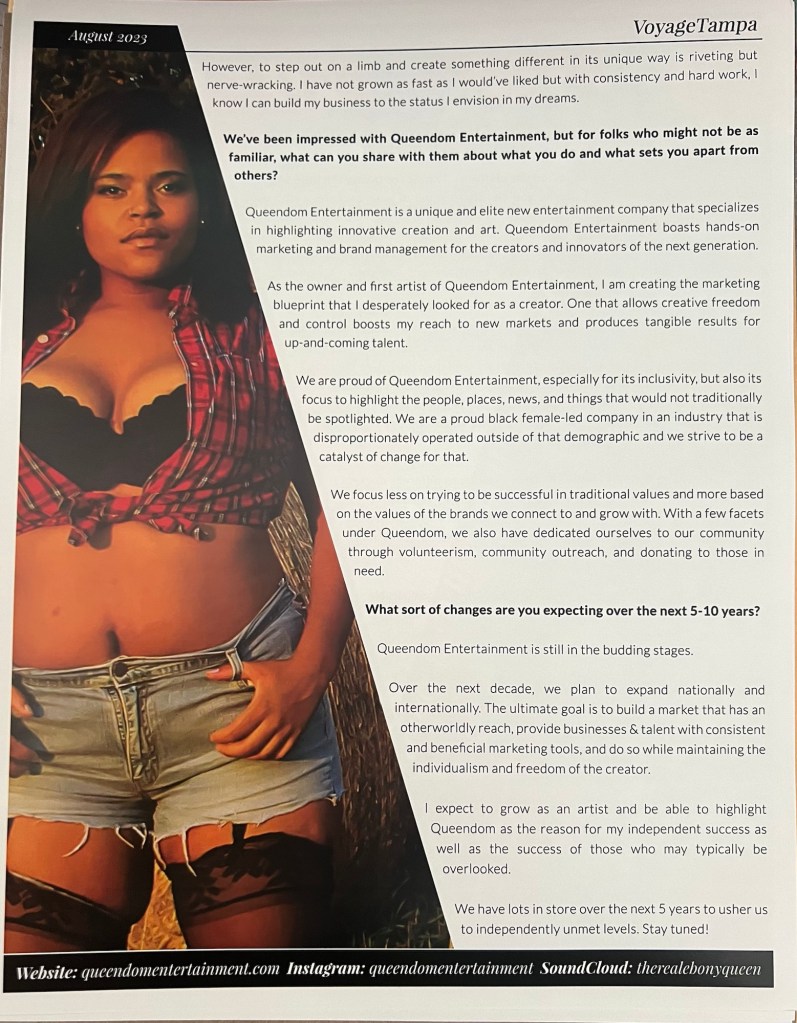
Thank you @voyagetampamag for the editorial-style prints of our recent interview ✨
The Queendom 👑 really enjoyed our interview and we hope to work with you all again in the future 💫 #LinkInBio #QueendomEntertainment #VoyageMag #VoyageMagTampa #Entrepreneur #Media #Interview #Artist #Model #Author #Queendom #QueendomEntertainment #EbonyQueen



 Queendom Entertainment
