This month’s book of the month is in honor of women’s history month, and of course, black history. I was watching the movie, Harriet, about Harriet Tubman, and was inspired by Harriet & Marie Buchanan’s storyline. Although Marie Buchanan, played by Janelle Monáe, was a fictional character it got me thinking about the stories of the women who escaped slavery, as well as, those who assisted the women who had escaped from slavery by introducing them to new life in the North.
The author Karen Cook Bell is a Professor of History and the Wilson H. Elkins Endowed Professor at Bowie State University. Her areas of specialization include slavery, the Civil War and Reconstruction, and women’s history.
Her non-fictional book “Running From Bondage” mirrors the work of William Still, who in the movie Harriet & in real life, collected slave stories and records of those searching for freedom on the Underground Railroad during & after The Revolutionary War. Karen’s work focuses specifically on the stories of the women during this time.
Synopsis:
“Running from Bondage tells the compelling stories of enslaved women, who comprised one-third of all runaways, and the ways in which they fled or attempted to flee bondage during and after the Revolutionary War. Karen Cook Bell’s enlightening and original contribution to the study of slave resistance in eighteenth-century America explores the individual and collective lives of these women and girls of diverse circumstances, while also providing details about what led them to escape. She demonstrates that there were in fact two wars being waged during the Revolutionary Era: a political revolution for independence from Great Britain and a social revolution for emancipation and equality in which Black women played an active role. Running from Bondage broadens and complicates how we study and teach this momentous event, one that emphasizes the chances taken by these ‘Black founding mothers’ and the important contributions they made to the cause of liberty.”
Nestled in the southern region of the modern-day country known as Nigeria is a city known as Benin. In history, it was known as The Benin Kingdom aka the Edo Kingdom. Benin came to be established by way of Edo people seeking liberation from their rulers, The Ogisos. The remnants of this culture are approx. 5,246 ancient artifacts housed in museums across the world, on display for admiration by the very cultures that looted the items from their land of origination. (“Benin Bronzes Online Database Goes Live with Details of Thousands of Looted Artefacts”). The most cumulative significant artifacts of this culture are “a group of sculptures which include elaborately decorated cast plaques, commemorative heads, animal and human figures, items of royal regalia, and personal ornaments” known as the “Benin Bronzes.” (“Benin Bronzes”)
The Benin Bronze casters began creating the figures before the 13th century but were not acquired for distribution to the museums until The Benin Expedition of 1897 by a British force, also known as “The Benin Massacre”. Per the British Royal Collection Trust, “The Oba (king) of Benin held great influence and prevented the Company from forming a monopoly in the region. In 1896, the Company decided to mount an expedition to depose the Oba and replace him with a council appointed by British officials.” (“Alan Boisragon (1860-1922) – The Benin Massacre / by Captain Alan Boisragon”) In February of 1897, the “Raid of Benin” commenced, resulting in the burning destruction of the Oba’s palace and ultimately, his exile from the land. The monarchs most precious artifacts were looted to destabilize the power of the King, thus, resulting in foreign museums being full of stolen ancient African artifacts. The exhibit selected holds most of these artifacts, in addition to the looted ones of many other cultures. They are put on display, in no specific order on the online exhibit, for admiration by those who are interested in seeing the cultures of the African people.
The Benin Bronzes boast a plethora of distinct artifacts. However, the most frequently discovered were known as the Benin Heads. These busts were created from carved elephant tusks, brass, and bronze. They were perched upon Benin Altars to symbolize the transference of power from late kings to the new king. The material used to create the bust was directly dependent upon the stature of the King it was created for. This ranged from the previously mentioned brass and bronze, to wood, and terracotta. (“11 Facts You Need to Know About Benin Art”) The Oba was tasked with forming and commissioning bronze casters and ivory carvers to create the art for the royal court.
Within the exhibit the masks are amongst other artwork that represent different things within the Benin culture. It also includes the artifacts of other African cultures which gives the artwork distinct significance and puts the differences between each culture and its artwork on display. As previously mentioned, other distinct notable artwork exclusive to the Benin culture are cast plaques with elaborate scenes of how the Benin perceived their trade partners, the Portuguese. According to the “Khan Academy,” the plaques depicted them with “their pointed noses, thin faces and beards and strange clothes.” (“Benin Plaques at the British Museum”) The artwork from the Benin culture tells specific stories, depending on which art you are ingesting. Seeing the the artwork in its entirety in an exhibit brings the Benin history to life and provides tangible evidence to support the vast, factual cultural significance of the Benin Empire.
Works Cited
“11 Facts You Need to Know About Benin Art.” Google Arts & Culture, artsandculture.google.com/story/11-facts-you-need-to-know-about-benin-art-yemisi-shyllon-museum-of-art/iAXxMDvz38PV8Q?hl=en.
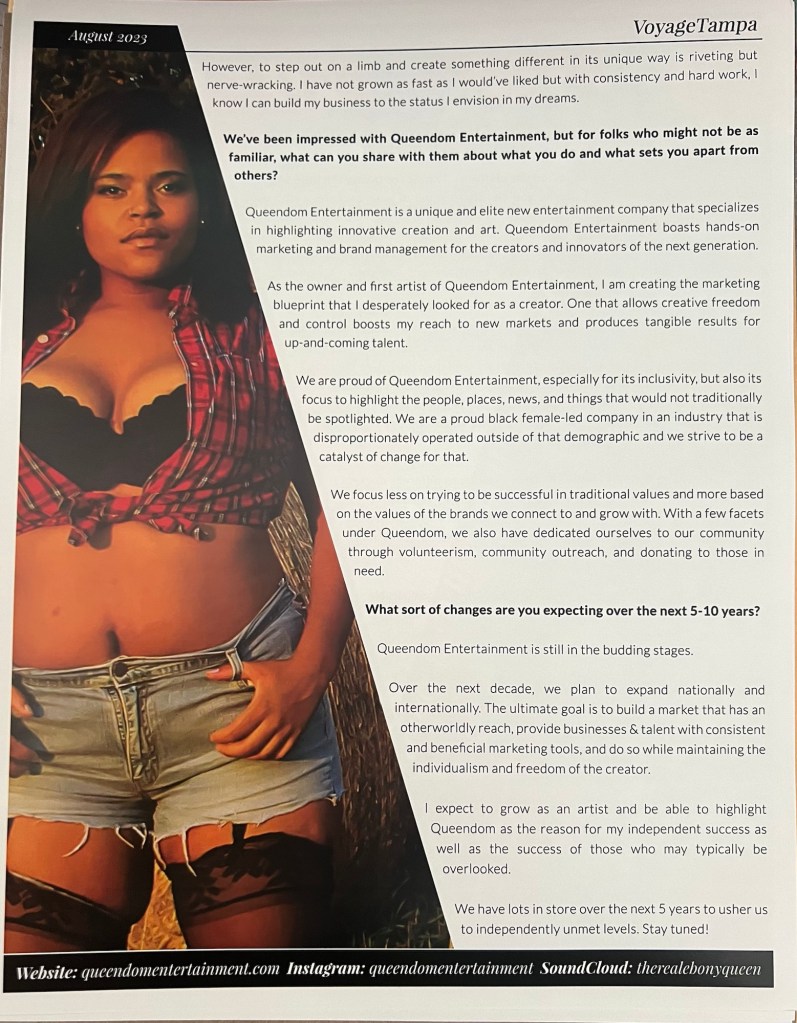
Thank you @voyagetampamag for the editorial-style prints of our recent interview ✨
The Queendom 👑 really enjoyed our interview and we hope to work with you all again in the future 💫 #LinkInBio #QueendomEntertainment #VoyageMag #VoyageMagTampa #Entrepreneur #Media #Interview #Artist #Model #Author #Queendom #QueendomEntertainment #EbonyQueen
Have you ever pulled a green thing off a cloth out of a freshly cleaned batch of laundry? Or maybe noticed some extremely sticky things on the tip of your shoes or in the cuffs of your jeans? They call that Goosegrass! While fascinating, it is also annoying and can be bothersome. The biological name of Goosegrass is Eleusine Indica. Eleusine Indica is a warm season, annual non-native grass commonly found in any disturbed sites throughout Florida. Most famously known for sticking to shoes and clothes until picked off, it is considered an invasive weed that can be particularly difficult to control. It blooms annually and can only be controlled with season-long herbicide treatment. It is categorized as a low alert level due to its ability to be maintained.
I know what you’re thinking, why not just get rid of it? Put simply, there does not seem to be any final solution to the overgrowth of the weed Goosegrass. With that information, it can be expected that it will continue to spread and prosper in environments that it can survive. “It is considered an invasive weed due to its vigorous growth and abundant seed production. Seeds germinate near the surface of moist soils with temperatures above 65°F (Chauhan and Johnson 2008).” (“HS1178/HS1178: Biology and management of goosegrass (Eleusine indica (L.) Gaertn.) in tomato, pepper, cucurbits, and strawberry,” n.d.) With Florida’s unique and supporting environment for growth, it is safe to assume that it will continue to spread and invade Florida’s biome. In addition, I must emphasize that it’s specific to the biomes that goosegrass can be expected to thrive in. Again, that is wet and moist lands.
While not yet possible to eliminate, it is controllable. “In plasticulture production systems, goosegrass can be controlled with the use of plastic mulches and hand pulling of small plants that emerge in the planting holes during the cropping period.” (“HS1178/HS1178: Biology and management of goosegrass (Eleusine indica (L.) Gaertn.) in tomato, pepper, cucurbits, and strawberry,” n.d.) Although the process described is not yet a process that is made easy or readily available to the public for personal overgrowth control, domestic sprays and weed control are available.With minimal effort, the inconvenience of goose grass can be minimized. I assume with further research; complete annihilation efforts will start.
While it is an invasive species, I do believe that it does not have a great enough negative impact on the vegetation and environment of Florida to be a pressing issue. It may stick to you but there is no evidence of it ever being fatal. I never personally experienced Goosegrass to the extent I have here in Florida. So, it does prove interesting to know it is an invasive species. However, I must say I have never lived in an environment as watery as Florida. As covered previously, it is mostly in wet and warm environments that the weed prospers. Goosegrass appears on a long stem as flat leaves with no hairs. Again, it is a nuisance, but not enough to trigger immediate investigative research into its annihilation. My favorite part about goose grass is picking it off!
Work Cited
HS1178/HS1178: Biology and management of goosegrass (Eleusine indica (L.) Gaertn.) in tomato, pepper, cucurbits, and strawberry. (n.d.). Ask IFAS – Powered by EDIS. https://edis.ifas.ufl.edu/publication/HS1178
Finding yourself is like the human version of the metamorphosis of a butterfly, the shedding of a snake, and the molting of a stick insect. It hurts and it takes a long time to become the best version of yourself but when it’s all said and done, it’s exactly what you were meant to do. When you’re young, you believe you are who you are and there is nothing else you could grow into. You like what you like, and you don’t like what you don’t… but as time goes on eventually you realize, time does change you.
It took me a long time to find the right avenue for my voice. With such a creative spirit inward, I feared exposing that part of myself to the world. I didn’t want to be judged by those who were committed to misunderstanding me. I didn’t want anyone attaching their own doubts and fears onto my dreams and art. I didn’t want to adhere to the standards of the industries I was trying to bud in. Now, at 30, I’m grateful for my youthful self. I was guarded and rightfully so, but now, I’m entering a new era of Ebony. It took 28 years, but I no longer fear the things I once did. I am Ebony. I am secure in who I am and know exactly where I’m going in life. If I want to fulfill the God-given purpose of my life, I must speak. I must free myself from the shackles of fear and allow GOD to put me in the positions I was meant for.
I think my fear stemmed from insecurity. My youth felt like a black abyss of endless dread. Now don’t get me wrong, I had a great childhood. My mother worked tirelessly to ensure my siblings and I had everything we could ever need. The abyss I’m referring to was in my head. I’ve always had this impending doom feeling in the back of my mind. Like, “why would it matter if I tried to pursue my dreams? We’re all going to die in the rapture soon anyway!”. Or, thinking to myself “I want to try out for the dance team in high school but maybe I am too fat and would make a fool out of myself”. As I grew older, I began to understand that this was rooted in my fears of failure. Instead of trying something new, I’d sabotage myself by talking myself down and making myself feel unworthy of big achievements. I missed out on a lot of opportunities and life that way. I don’t want to do that anymore.
Thus, why it was so important to address it here and now. As I continue to blossom into the powerhouse woman that I aspire to be, the flood gates of creativity have opened. I’m not surprised though; my success seems to be connected to how much I am willing to let my inhibitions go. As I grow, I have felt the desire to share my most personal art strengthen with the hope of connecting to the audience that relates to me. Those who are full of talent but sit quietly in the back waiting for something to ask for us to show it off. Those who want their art to be so painstakingly perfect that they become paralyzed with perfectionism and don’t ever begin. This is for us.
We have the right to take up space. We were born to express ourselves and create art that will beautify our lives and the world. With that said, as I embark on this journey of freeing myself from the shackles and sharing more of my world, I can only pray that I touch someone out there. I pray that I inspire them to chase their dreams sooner, let go of their self-doubts, and let life take its course. Our stories were written long before we touched Earth, we just have to read the book of our own life every day with faith and without fear to achieve true happiness.
We’re kicking off our health goals this month with @yogawithnico Body,Mind, & Soul: 30 Days of Transformation 🦋
With easy accessibility, beginner friendly alternatives throughout, and extensive yoga vocabulary Nico’s channel has a plethora of amazing yoga videos to add to your daily regime 🏋🏾♀️
Join us on the 30 day transformation today !! 🧘🏾♀️
Welcome to First Quarter 💰 On the financial calendar of a company, a quarter is a three-month interval that serves as the foundation for regular financial statements and dividend payouts. 📈
What are your business goals for Q1? ✨ Drop them in the comments ⬇️⬇️⬇️ #QueendomEntertainment #Queendom #Business #Vocab #Quarter #Q1 #NewYear
2024 is nearly here & we’re closing out our 1st annual New Year Reset Plan 🫧
Check out our last two posts for the 1st and 2nd stages of the RESET: RELEASE and RENEW 🔮
The final stage of the RESET is REFINE 📖
Remember! These tasks can be accomplished in any order at anytime before the NYE countdown 🎆
Finish off the year strong by knocking out these last few tasks with the intention of remembering who you are & where you’re going! 🏁
⬜️ Reflect on the promises you’ve previously made to yourself.💭 How many of them did you accomplish this year, were there setbacks? 🤔How do you plan to move forward? 🌱Write these goals and plans out in a safe place and refer to them throughout the year to remind yourself of your purpose when needed! 🗯️
⬛️ Cut the cord ✂️ by removing anything (or anyone 👀) that is weighing you down before the end of the year. Have those hard convos with people that you’ve been avoiding! Endings are new beginnings. 🙌🏾 If it’s weighing on you now, it’ll still be weighing on you next year until you let go. Free yourself from the expectations of the world and people. Practice all the cleansing rituals needed to go into 2024 feeling light and full of hope ✨
◽️Lastly, update your bucket list! ✈️ What countries do you want to visit over the next five years? 🌍 What attractions are must-do experiences in 2024? 🎢 Do you have anything you want to buy that you have to save up for? 💰Scratch off the tasks you’ve completed and add more to keep life adventurous and thriving ⚡️
This concludes Queendom’s 2024 New Year RESET 🔃
Stay tuned as we close out 2023 with a bang 💥 at QueendomEntertainment.com




 Queendom Entertainment
