
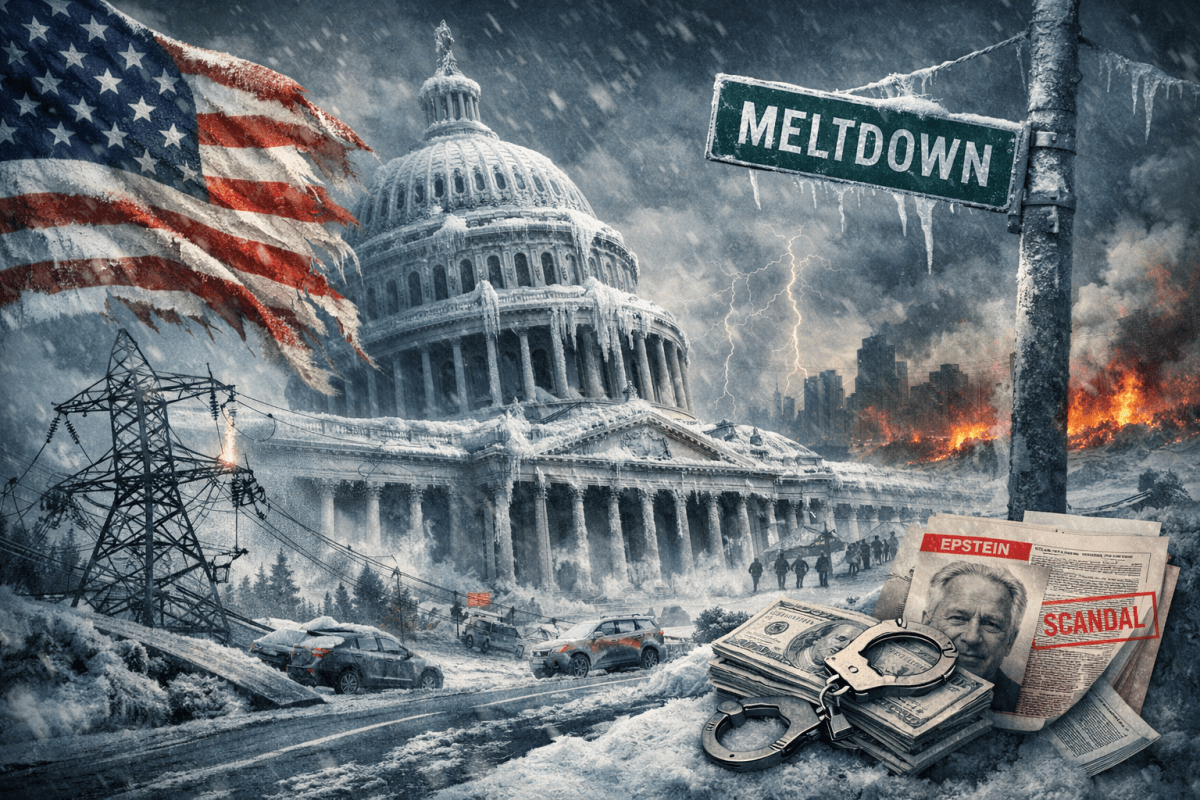
The last time it snowed in Tampa, it was 1977. Fast forward, January 2026, and the entire U.S. is under ice storm warning/ freezing weather watch. Although the time frame of the storms are aligned with normal Winter month behavior, this year things were different… It was unusually hot throughout the holidays everywhere. That all ended in January when this Arctic blast shook the nation, collapsing full power grids almost simultaneously as the government power structure in our society seemed to collapse.
Chronologically, this year has quite a few significant anniversaries that are more than befitting for the times. Coincidental, even. America will reach its 250th birthday this year. If you aren’t aware, there is a theory derived from John Glubb’s The Fate of Empires, which explores “analyzing history from Assyria to modern times, Glubb identified a common life cycle: Age of Pioneers, Conquest, Commerce, Affluence, Intellect, and Decadence. Decadence is characterized by economic inequality, materialism, and societal apathy.”
Based on Glubb’s theory, “America appears to have reached the age of decadence, which Glubb defines as marked by “defensiveness, pessimism, materialism, frivolity, an influx of foreigners, the welfare state, (and) a weakening of religion.” (Thomas, 2015) Per Roz Savage’s layout, these different ages span over a number of years each, with Decadence being one of the final ages;
- The Age of Pioneers: expansion of territory
- The Age of Conquests: more expansion, not always peaceably
- The Age of Commerce: wealth is created through trade and innovation
- The Age of Affluence: all appears to be well, but the seeds of destruction are being sown
- The Age of Intellect: the acquired affluence enables people to pursue the life of the mind. Academic institutions may produce sceptical intellectuals who start to question the dominant narratives of the empire, undermining its authority
- The Age of Decadence: people indulge in excessive consumption in the pursuit of happiness, while in actuality becoming less happy. The civilisation creates diversions for the populace, from gladiator fights to Facebook and Instagram, while people indulge in addiction and debauchery. The values and discipline that enabled the creation of the empire are eroded
- The Age of Decline and Collapse: inequality grows, increasing numbers are excluded from meaningful work and the means to fulfil their potential. Discontent leads to disruption and the empire collapses.
(Savage, 2019)
Furthermore, in coincidental alignments, February 2026 is the 100th anniversary of the federally recognized celebration of Black History Month. In the 1920’s, the prominent Dr. Carter G Woodson created Negro History Week and architected the annual celebration of Black American accomplishments known as, Black History Month. “As the son of formerly enslaved parents, Dr. Woodson understood that denying people of their history denies them of their humanity. “Those who have no record of what their forebears have accomplished lose the inspiration which comes from the teaching of biography and history,” he wrote.” (Melville, 2026)
I could continue on for days with coincidentally aligned dates and times but these two are the most prominent and eerily befitting human events that are echoing their sentiments in this new year. Most Americans, for the first time in decades, are entering the territory of an authoritarian government which, most of us working age and below, have never had to deal with personally on an immediately direct level. The most powerful person in our government is a rouge decoy for all the ultra-rich, powerful people pulling the corruption strings behind the scenes. But for the first time in a very long time, people are fed up and more riled up than ever. Not just politically and financially, but socially and professionally. For years, every single person in America has felt the bubbling up or been directly impacted by a society that is rapidly declining.
January 2026’s Final Frost highlighted the immeasurable depth of corruption that is being inflicted on Americans and negatively impacting our every day lives. The ice storm exposed the weakness of our power sources from the root to the shoot. Power grids across the country failed due to overload. People reeled over the funds they lost preparing for a storm that wasn’t nearly as bad as was predicted. In defense of the meteorologists, we were warned that Trump’s gutting of NOAA & NWS would directly correlate to discrepancies in reporting. “The Trump administration’s 2026 budget appears to be actively working to eliminate the Office of Oceanic and Atmospheric Research (OAR) along with all NOAA weather laboratories and cooperative institutes and laboratories, which provide weather forecasting data and research from 80 universities and work to improve NOAA’s warning and forecast capabilities. Without continued funding, long-term datasets would be disrupted and the NWS’ ability to inform disaster preparation and provide accurate and timely weather tracking would be at risk. Moreover, the president just signed into law the “One Big Beautiful Bill Act,” which, among other dangerous provisions, repealed all unobligated funds that the Biden administration had designated for improving research, forecasting, monitoring, and public communication of hazardous weather.” (“Lasting Threat of Trump’s Cuts to NOAA and NWS on American Communities,” n.d.)
While Americans faced the physical impacts of cutting crucial funding for weather reporting, Trump’s DOJ released over 3 million files on January 30th 2026 about the case surrounding notorious child sex offender, serial rapist, and human trafficker Jeffrey Epstein. This file drop cemented the publicly known notion that not only is the sitting president directly involved in the Epstein scandal, so is a large number of mostly prominent ultra-wealthy men whose crooked business dealings benefited off the backs of hardworking, law abiding citizens. Everyone from politicians to celebrities were exposed sending the western world into a frenzy. What now? How can a country where citizens are subjected to torturous policing, corrupted government officials, and invasive surveillance, suddenly be so lenient on the western world’s most powerful figures using money and connections to inflict world changing, immeasurable pain on a mass scale? How can a world that has normalized the rich eating the meek truly be sustainable? Truth is, it can’t and it won’t.
John Glubb told us, with evidence, in 1977 that America may have been on the brink of its collapse. “Glubb says the 250-year average of empires has not varied in 3,000 years, but we don’t learn from history because “our studies are brief and prejudiced.” He means they are mostly about one’s own country.” (Thomas, 2015) Although, it may not be 250 years to date, it’s safe to say that there is no American right now who is absolutely sure about what life beyond Trump and his corruption looks like. We’re in the thick of it and January’s final frost may have been the frigid, sharp wake up that American’s who believe in the Constitution needed. As Dr. Woodson wrote, ““Those who have no record of what their forebears have accomplished lose the inspiration which comes from the teaching of biography and history,”(Woodson, 1993,)
References
The Lasting Threat of Trump’s Cuts to NOAA and NWS on American Communities. (n.d.). Center for American Progress. https://www.americanprogress.org/article/the-lasting-threat-of-trumps-cuts-to-noaa-and-nws-on-american-communities/
Melville, D. (2026, January 5). 2026 Marks The 100th Anniversary Of Black History Month — A Brief History. Forbes. https://www.forbes.com/sites/dougmelville/2026/01/05/2026-marks-the-100th-anniversary-of-black-history-month—a-brief-history/
Savage, R. (2019, October 17). The rise and fall of the human empire. Roz Savage | MP|Ocean Rower|Speaker|Author. https://www.rozsavage.com/the-rise-and-fall-of-the-human-empire/
Thomas, C. (2015, January 4). Thomas: Will decadent America reach empires’ average age of 250 years? https://www.lubbockonline.com/. https://www.lubbockonline.com/story/opinion/columns/2015/01/04/thomas-will-decadent-america-reach-empires-average-age-250-years/15000869007/
Woodson, C. G. (1993). The mis-education of the Negro.





 Queendom Entertainment
